Prices verified: March 2026
Have more questions about National Theatre of Bucharest (Teatrul National Bucuresti)? Ask Bucur.History
The National Theatre of Bucharest (Teatrul National “I.L. Caragiale”) traces its origins to 1852, when it was established as Romania’s first national dramatic arts institution. Named after Ion Luca Caragiale — Romania’s greatest playwright, whose sharp satirical comedies remain as relevant today as they were in the 1880s — the theatre has played a central role in Romanian cultural life for over 170 years.
The original 19th-century theatre building was located on Calea Victoriei and was destroyed during World War II bombing in 1944. After the war, the company performed in various temporary venues until a new building was constructed on Bulevardul Nicolae Balcescu, completed in 1973. This communist-era structure, designed by architect Horia Maicu (who also designed Casa Presei Libere), was a massive concrete edifice in the brutalist style.
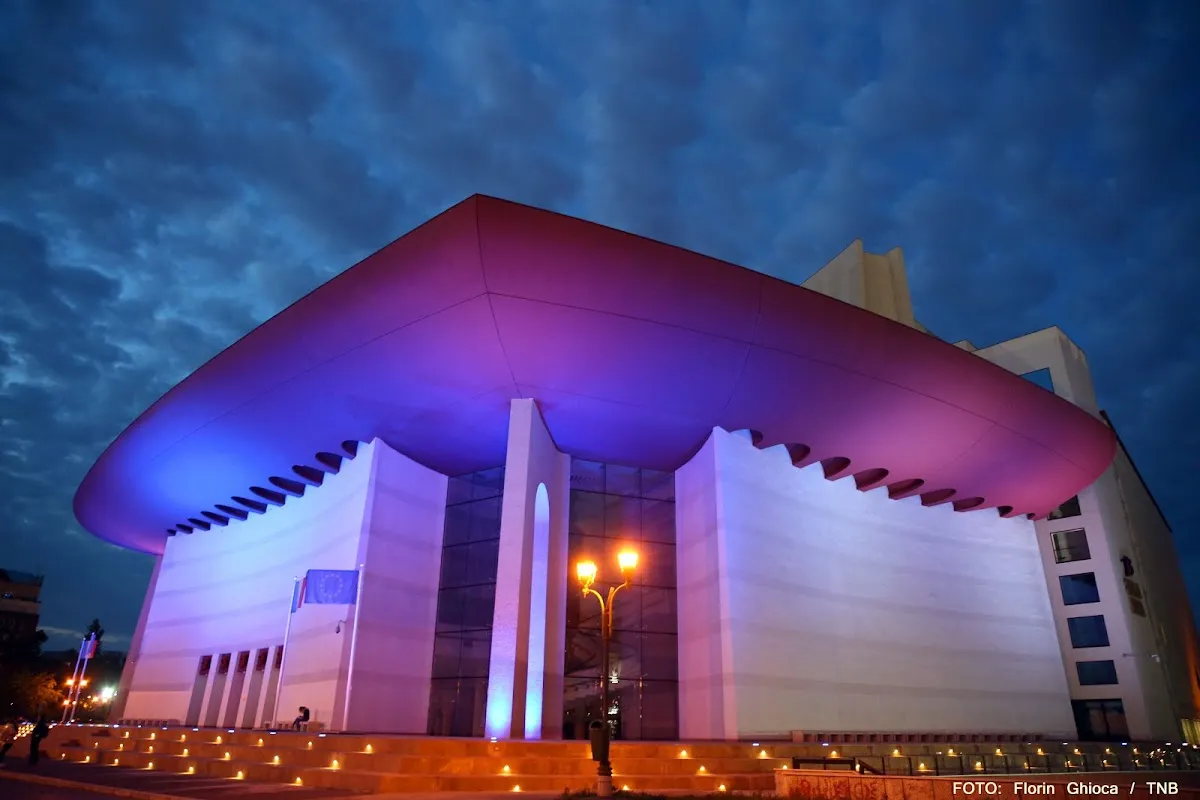
After the 1989 Revolution, the building underwent a controversial exterior renovation in the early 2000s that added glass facades, metal cladding, and modernist elements to the communist-era shell. The result divided opinion in Bucharest — some see it as a bold modernization, others as an awkward hybrid. Whatever your view of the exterior, the interiors were thoroughly upgraded with modern stage technology, acoustics, and audience facilities.
Today the National Theatre operates multiple performance halls and stages one of the most ambitious programs in Eastern European theatre, mixing classical Romanian works with international contemporary drama.
What to See
- The building itself — love it or question it, the glass-and-metal exterior over the brutalist core is one of Bucharest’s most distinctive modern structures
- A performance — the primary reason to visit; the repertoire spans classical Romanian plays (especially Caragiale), international drama, and contemporary works
- The main auditorium (Sala Mare) — a 1,000-seat hall with modern acoustics and staging
- The Ion Caramitru Studio — a smaller, more intimate performance space for experimental and contemporary work
- The surrounding plaza — the theatre sits on a broad boulevard with fountains and green spaces, a popular gathering point in central Bucharest
- The underground passage murals — the pedestrian underpasses near the theatre feature murals and art installations
Tips for Visiting
See a show. The theatre is worth visiting for a performance, not just the building. Even if you do not speak Romanian, the quality of the acting and staging is often remarkable. Some productions have English surtitles — check the website.
Book in advance for popular productions. Caragiale’s plays and major international productions sell out. The box office and online booking are straightforward.
Tickets are affordable. By Western European standards, Romanian theatre tickets are a bargain — high-quality productions for 30 to 150 RON.
The building is best seen at night. The glass facades are illuminated after dark, and the building is far more striking with the lighting on.
Getting there: The theatre is between Piata Unirii metro (M1, M2, M3) and Universitate metro (M2), about 5 to 7 minutes walking from either. It is right on Bulevardul Nicolae Balcescu, impossible to miss.
Combine with: The Old Town is a 5-minute walk west. Piata Universitatii and the Sutu Palace are immediately adjacent. The Romanian Athenaeum and Revolution Square are a 15-minute walk north along Calea Victoriei.
Is It Worth It?
As a building to admire from outside, the National Theatre is a 15-minute stop — interesting architecturally but not a must-see in its own right. As a place to see a performance, however, it is one of the best cultural experiences Bucharest offers. Romanian theatre has a strong tradition, the productions are consistently high quality, and the prices are accessible. If you have an evening free and the programme has something that appeals to you, go. You will not regret it.
A Glimpse into the Past
The old National Theatre building -- the original 1852 theatre was severely damaged in World War II bombings, rebuilt, then demolished by Ceausescu in 1984
Photo: Bogdan · CC BY-SA 3.0 · Wikimedia Commons
The original National Theatre on Calea Victoriei, 1856 -- photographed by Ludwig Angerer, this building housed Romania's national stage before its destruction in the 1944 bombings
Photo: Ludwig Angerer · Public domain · Wikimedia Commons
Bulevardul Nicolae Balcescu 2, Sector 1, Bucuresti
Open in Google Maps