Prices verified: March 2026
Have more questions about Revolution Square (Piata Revolutiei)? Ask Bucur.History
Known as Palace Square until 1989, Revolution Square was renamed after the dramatic events of December 1989. On December 21, thousands of people gathered to hear a speech by Ceausescu from the balcony of the Central Committee building. The crowd turned against the dictator, and he fled by helicopter from the building’s rooftop the following day. This marked the beginning of the revolution, which resulted in the execution of Ceausescu and his wife Elena on December 25, 1989.
Over 1,000 people died in the fighting across Bucharest. The square has been a center of power for centuries — the former Royal Palace was built here in the 19th century, and the area has witnessed many of Romania’s most pivotal moments.
What to See
- Memorial of Rebirth — a 25-metre-tall monument honoring revolution victims, with a wall listing the names of 1,058 victims. Controversial among locals, who nicknamed it “the olive on a stick”
- Former Royal Palace — now the National Museum of Art of Romania (MNAR), housing European and Romanian art collections including works by Rembrandt, Monet, and Brancusi
- Central Committee Building — the balcony from which Ceausescu gave his final speech (now the Ministry of Interior)
- Kretzulescu Church — an Orthodox church built 1720-1722, one of Bucharest’s best-preserved
- Athenee Palace Hotel — a historic luxury hotel dating from 1914, with stories of espionage and intrigue
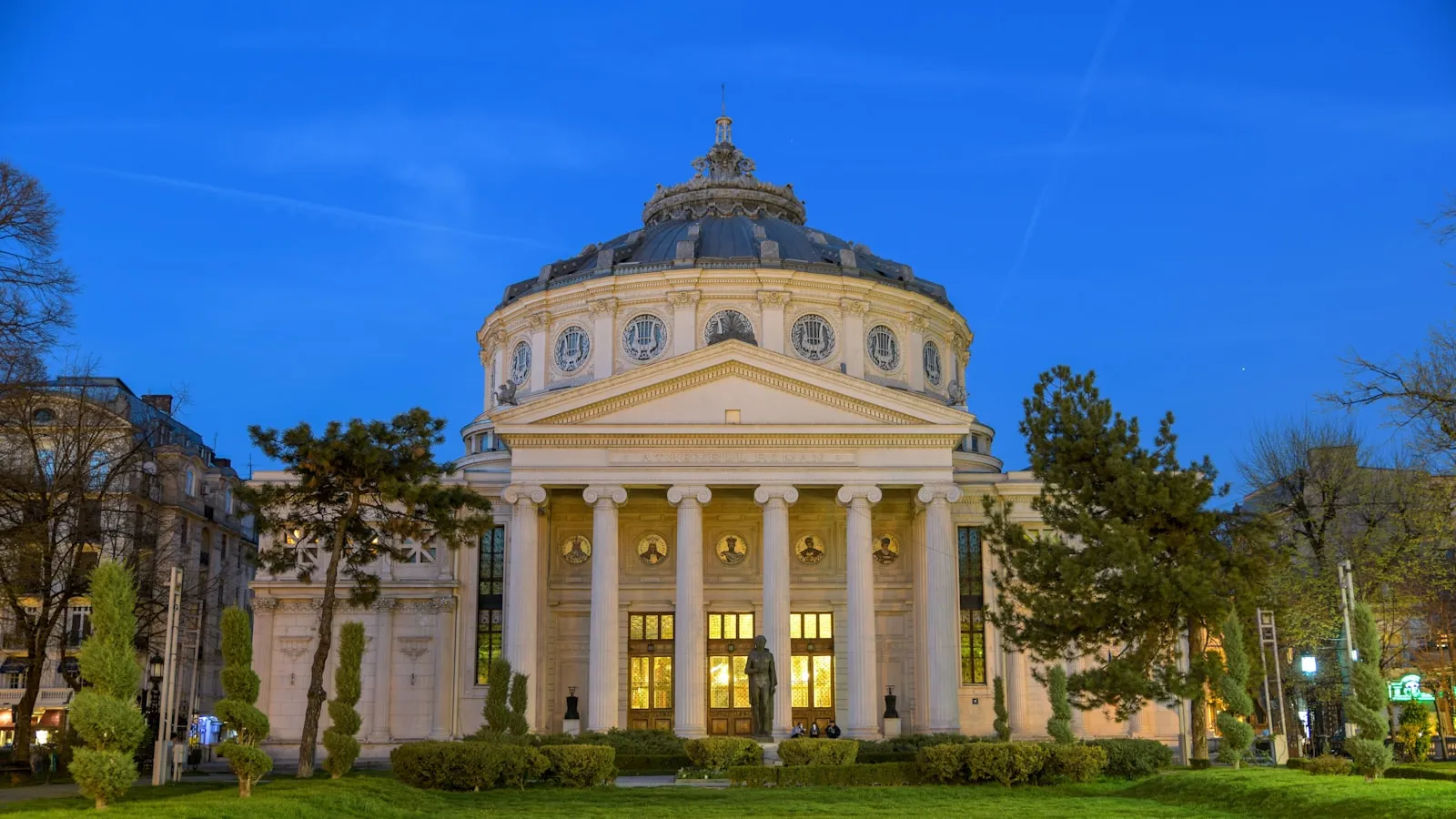
- Romanian Athenaeum — just steps away at the northern edge of the square
“If you stand in the center of Revolution Square and turn slowly, you can see the Royal Palace, the Communist Party headquarters, a memorial to a revolution, and one of Europe’s finest concert halls. Few squares compress so much history into so small a space.”
Tips for Visiting
Context matters: The square is best understood with historical knowledge. Consider joining a guided walking tour that covers the 1989 revolution — the stories bring the location to life.
Look for bullet holes: They can still be seen on some buildings surrounding the square, physical reminders of the fighting.
Visit MNAR: The National Museum of Art of Romania is world-class and often overlooked by visitors. Allow 1.5-2 hours for the collections.
Evening: The buildings are particularly striking when illuminated at night.
Getting there: Metro to Universitate (M2), then walk 5 minutes north along Calea Victoriei. Or metro to Piata Romana (M2) and walk 8 minutes south.
Is It Worth It?
Essential. Revolution Square is where Bucharest’s past and present collide most powerfully. Even if you do not enter any museum, standing in the square and understanding what happened here in December 1989 is one of the most moving experiences the city offers.
A Glimpse into the Past
Revolution Square (then Piața Palatului) in the interwar period -- the square that would witness the dramatic events of December 1989
Photo: Unknown author · Public domain · Wikimedia Commons
The Kretzulescu Church in 1990 -- the 18th-century church in Revolution Square witnessed the dramatic events of December 1989 that toppled Ceausescu
Photo: Wikimedia Commons · CC BY-SA 3.0 · Wikimedia Commons
Piata Revolutiei, Calea Victoriei, Sector 1, Bucuresti
Open in Google Maps